Do You Want to Learn About Reasoning With Chance and Uncertainty?
Students in economics, certain areas of psychology, math and the philosophy of science, will find the video course material on probability helpful. This content is in video course #7:
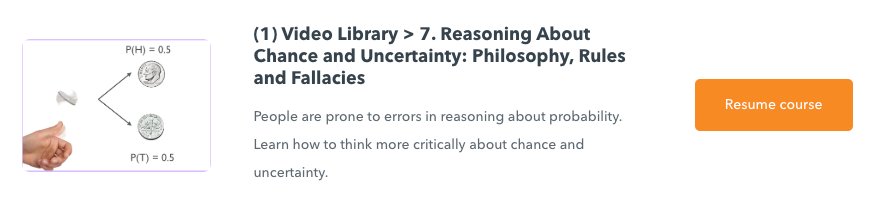
I originally produced these videos when I was teaching courses in the philosophy of science and scientific reasoning (I needed to talk about so-called "Bayesian" approaches to scientific methodology), and courses on critical thinking that included units on fallacies of probabilistic reasoning (e.g. when is a coincidence a sign of an underlying causal connection, and when is it just a coincidence?).
I also had to introduce a lot of this material when I was teaching the philosophy of physics (what does quantum theory say about chance and randomness in nature?).
Later I learned that the groundbreaking work in behavioral economics, that introduced the whole "cognitive biases and heuristics" research program in psychology, originated in efforts to empirically test whether human beings actually reasoned about chance and uncertainty in accordance with the formal rules of probability (spoiler: they don't).
So, while this is a "niche" topic for sure, it's philosophically very rich, and of practical importance in many areas of science and technology.